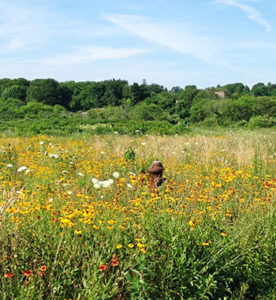
As another field season comes to a close, we look back on the work and contributions of the Fishers Island Conservancy Sentinels during the 2025 season. Their efforts supported ongoing monitoring, research, and stewardship projects across Fishers Island.
2025 Sentinels
Riley Tracy
George Hanes
Campbell Strong
Diane Lang
Burke Cameron
Eva Ermlich
2025 Interns
Elsie Harrington
Nicolas Hall
Field Work and Site Monitoring
The FIC Sentinel Site Monitoring protocol was modified this season to focus observations on birds, mammals, marine debris and any unusual sightings. This was done to provide robustness and actionable findings to the field data. Sentinels were assigned sites and requested to monitor their sites on a regular basis for consistency. Collecting photos at the sites and uploading them to the iNaturalist Fishers Island Biodiversity project as an important validation step was emphasized at a pre-season team meeting. Data was collected by 5 Sentinels at 9 sites and included 430 observations. Infographics and data plots are shown below.
An analysis was performed to ascertain the number and location of observed piping plovers in 2025 to identify if new nesting locations were observed. 34 piping plover observations were recorded by Sentienls, and all were observed at South Beach so no new nesting locations were recorded in the 2025 data set.
A review of the percentage of observed categories was conducted (see Fig 1. below) and as in past years, the vast majority of data collected in bird observations which accounts for 69% of the data. The next highest category was insects at 11.7% followed by observations of humans at 5.2%. Due to the change in priorities for the field monitoring data categories for this season, it may be difficult to make direct comparisons with previous data sets. We will have to monitor the shifts in data categories going forward to see if the change in protocol has an impact on the robustness of the data.
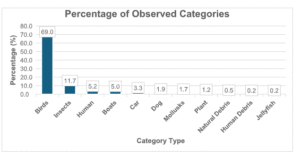
Fig.1 Percentage of Data Categories Observed 2025
An analysis of the bird types observed in 2025 was conducted and is shown below. The bird names are presented at the right of the figure in descending order with Herring Gull being the most observed bird type reported in 2025 at 26.49%. Many birds were observed at low percentages and could not be included in the figure. The table of a bird observation percentages are shown after Figure 2.
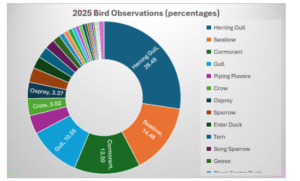
Fig. 2 A Doughnut Chart Showing the Percentage of Bird Types Observed in 2025
| BIRD ID | Percentage |
|---|---|
| Herring Gull | 26.49 |
| Swallow | 14.48 |
| Cormorant | 13.50 |
| Gull | 10.55 |
| Piping Plovers | 3.81 |
| Crow | 3.50 |
| Osprey | 3.37 |
| Sparrow | 3.00 |
| Eider Duck | 2.47 |
| Tern | 2.36 |
| Song Sparrow | 2.00 |
| Geese | 1.57 |
| Black Scoter Duck | 1.00 |
| Grey Catbird | 1.00 |
| Killdeer | 0.90 |
| Great Black Backed Gull | 0.78 |
| Common Yellowthroat | 0.67 |
| Oystercatcher | 0.67 |
| Red Wing Blackbird | 0.67 |
| Egret | 0.45 |
| Spotted Sandpiper | 0.45 |
| Blackbacked Gull | 0.34 |
| Blackbird | 0.34 |
| Northern Mockingbird | 0.34 |
| Blue Heron | 0.22 |
| Least Sandpiper | 0.22 |
| Pheasant | 0.22 |
| Sanetering? | 0.22 |
| Cedar Waxwing | 0.11 |
| Common Night Hawk | 0.11 |
| Dragonfly | 0.11 |
| Eastern Towhee | 0.11 |
| Goldfinch | 0.11 |
| Great Blue Heron | 0.11 |
| Lest Tern | 0.11 |
| Northern Cardinal | 0.11 |
| Sail Boat | 0.11 |
| Sooty Sheerwater | 0.11 |
| American Duck | 0.03 |
Horseshoe Crab Tagging and Population Count
For a second year, FIC Sentinels and Interns participated in the Horseshoe Crab Tagging and Population study conducted in partnership with NYSDEC & Cornell University. Based on observations and concerns from 2024, Island People’s Project (IPP) installed a floating buoy marker line (see photo below) at Dock Beach instead of the full-length swimming net that had been used in 2024. A concern was raised that the swimming net was preventing the Horseshoe crabs from accessing the beach and impacting spawning as no crabs were observed at Dock Beach after the net was installed. In 2025, spawning Horseshoe crabs were observed after the installation of the floating buoy net and into early July. A poster summarizing the results was prepared and presented at the FIC Nature Day on August 2, 2025. It was also shared with IPP along with a note of thanks for their support on this joint effort of success.
2025 Horseshoe Crab Tagging Poster
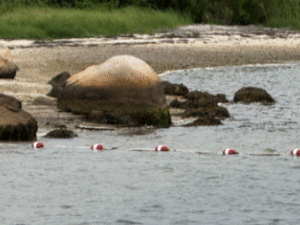
Floating buoy swimming marker at Dock Beach.
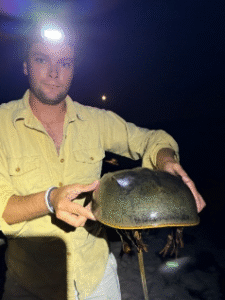
FIC Intern Nicolas Hall preparing to tag a Horseshoe crab in May, 2025.
Knotweed Clearing
On June 30, 2025, Sentinel Riley Tracy, Stephanie Hall & Diana Fisk cleared several bullion bags of knotweed along the Rec Path.
Two additional knotweed clearing dates occurred on the 2nd and 23rd of July. The FIRST Team joined Riley Tracy along with other volunteers (see photos below)
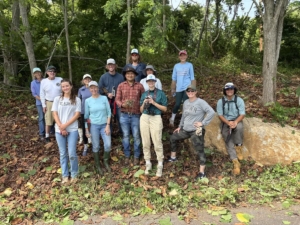
The FIRST team, Riley Tracy and volunteers for the two knotweed clearing days in July 2025
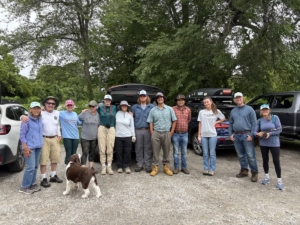
The FIRST team, Riley Tracy and volunteers for the two knotweed clearing days in July 2025
Beach Profiling
Intern Elsie Harrington initiated a coastal management project called beach profiling to monitor changes in the topography of island beaches as a result of erosion caused by storms and seasonal shifts. She initiated a collaboration with Brian Oakley, a professor at Eastern Connecticut State University who has conducted long-term studies of Block Island and Watch Hill beaches in Rhode Island. He uses the Emory method to monitor seasonal and long-term changes in shorelines. He came to Fishers Island in January 2025 to train several residents including Nicolas Hall, Michele Klimczak, Aleks Norton and Stephanie Hall. Several sites were assessed as potential locations for beach profiling and it was determined that 3 locations (South, Chocomount and Isabella beaches) were best suited for this. In June 2025, permanent were installed at these locations. Two markers were installed at Isabella beach for a total of 4 markers. Data was collected several times throughout the summer and fall to establish a robust baseline for future comparisons. Once a good baseline is established, the plan is to monitor these locations every 2 months.
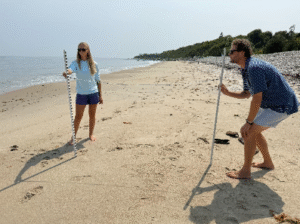
Elsie Harrington and Nicolas Hall performing beach profiling at Isabella Beach.
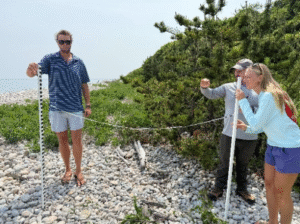
Nicolas Hall, Elsie Harrington and Bryan Oakley, PhD ECSU
Nature Day
George Hanes and Nicolas Hall (see photos below) participated in the FIC Nature Day held on August 2,2025 where they presented a poster describing the Horseshoe Crab Tagging and Population Study results for 2025.
We are grateful to all of our Sentinels, interns, partners, and volunteers for their time and commitment throughout the 2025 season. Their work continues to support long term conservation and monitoring efforts on Fishers Island.
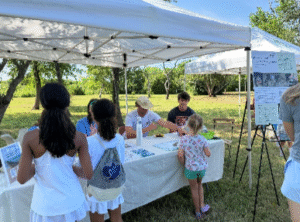
Nicolas Hall and George Hanes interacting with youth at Nature Day.
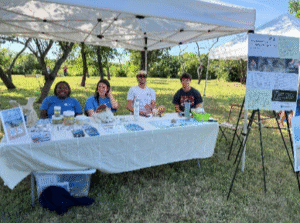
Mystic Aquarium Interns with Nicolas Hall and George Hanes at Nature Day.
We are grateful to all of our Sentinels, interns, partners, and volunteers for their time and commitment throughout the 2025 season. Their work continues to support long term conservation and monitoring efforts on Fishers Island.
Written by Stephanie Hall