
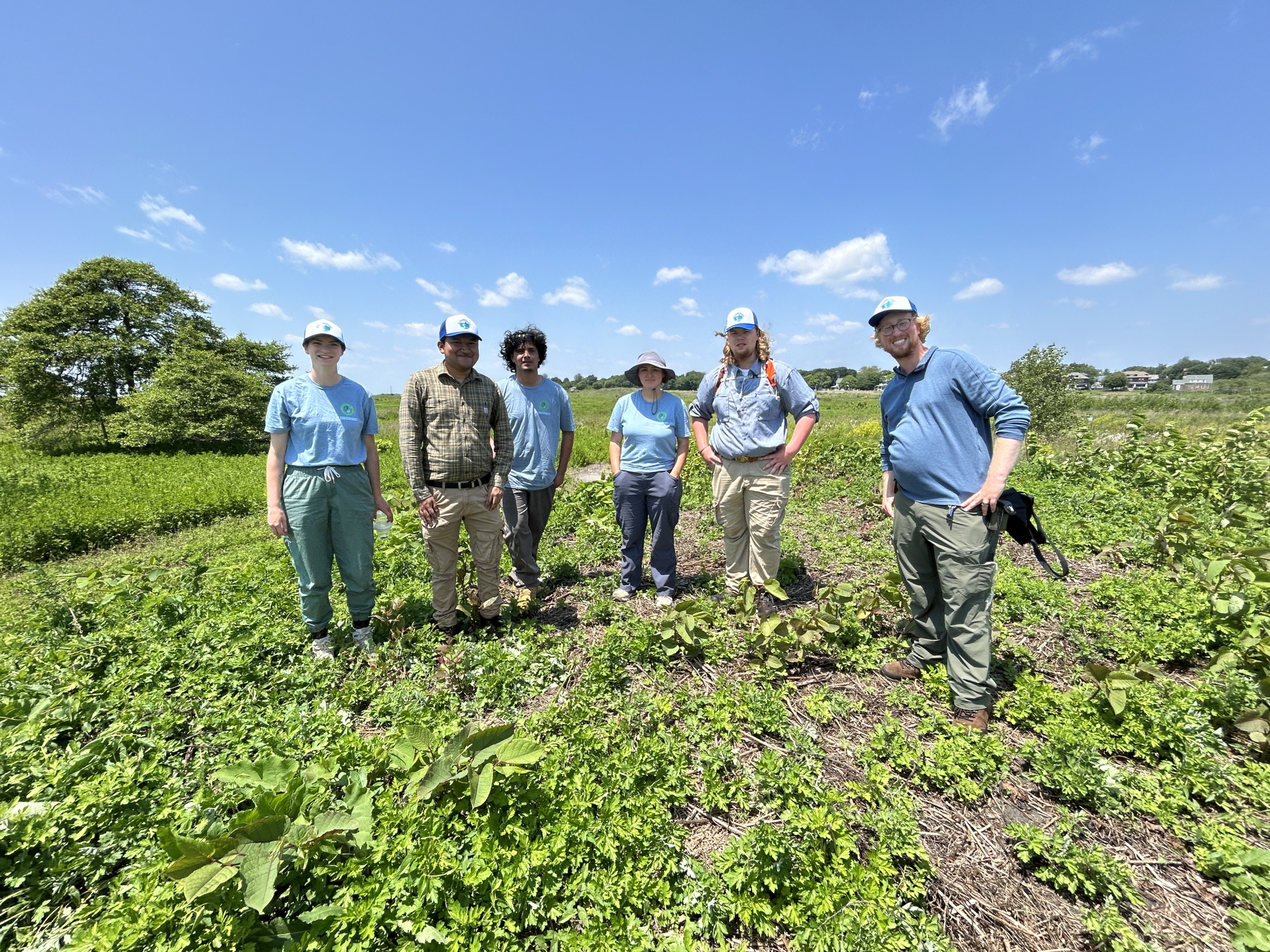
the 2025 FIRST Team
The 2025 field season marks our second year partnering with the Fishers Island Research and Survey Team from Tarleton State University. This collaboration continues to strengthen the Conservancy’s long term ecological monitoring across the island.
Under the guidance of Dr. Adam Mitchell, this year’s team supported vegetation surveys, bird and insect monitoring, invasive species management, and long term data analysis. Some students spent their days in the field conducting hands on surveys, while others worked behind the scenes digitizing specimens and analyzing years of collected data.
Each student brought curiosity, dedication, and a strong interest in conservation. Together, they contributed meaningful research that will help guide future stewardship decisions on Fishers Island.
Team Members
Tyler McMahon
Tyler is a first year PhD student in Wildlife and Natural Resources. His previous research examined how bison reintroduction in Illinois tallgrass prairies influenced moth diversity. On Fishers Island, Tyler led field surveys, supported invasive species management, and expanded the nocturnal insect sampling program. His enthusiasm for moths and butterflies added a new dimension to our insect monitoring work.

Jose Alvarez
Jose is a junior majoring in Wildlife Ecology and Management. Interested in habitat management and conservation outreach, he spent the summer building hands on research skills and exploring questions related to local wildlife, including carnivore ecology.

Walker Barak
Walker, also a junior in Wildlife Ecology and Management, hopes to pursue a career working with carnivores and rangeland systems. On the island, he focused on understanding species interactions and how habitat management shapes wildlife communities.

Emma Clarke
Emma is a senior majoring in Zoo and Confined Wildlife Biology and Management. With an interest in endangered species recovery, she contributed to shorebird monitoring efforts and helped evaluate protection strategies for nesting species on the island.

Francisco Salgado
Francisco is a sophomore in Zoo and Confined Wildlife Biology and Management and returned for his second summer with FIRST. His work centered on grassland bird monitoring and evaluating the use of bird boxes in restored habitats.

Naomi Zahn
Naomi, a junior in Wildlife Ecology and Management, also returned for a second season. Passionate about insect–plant interactions, she led research examining how invasive species management practices affect arthropod communities.
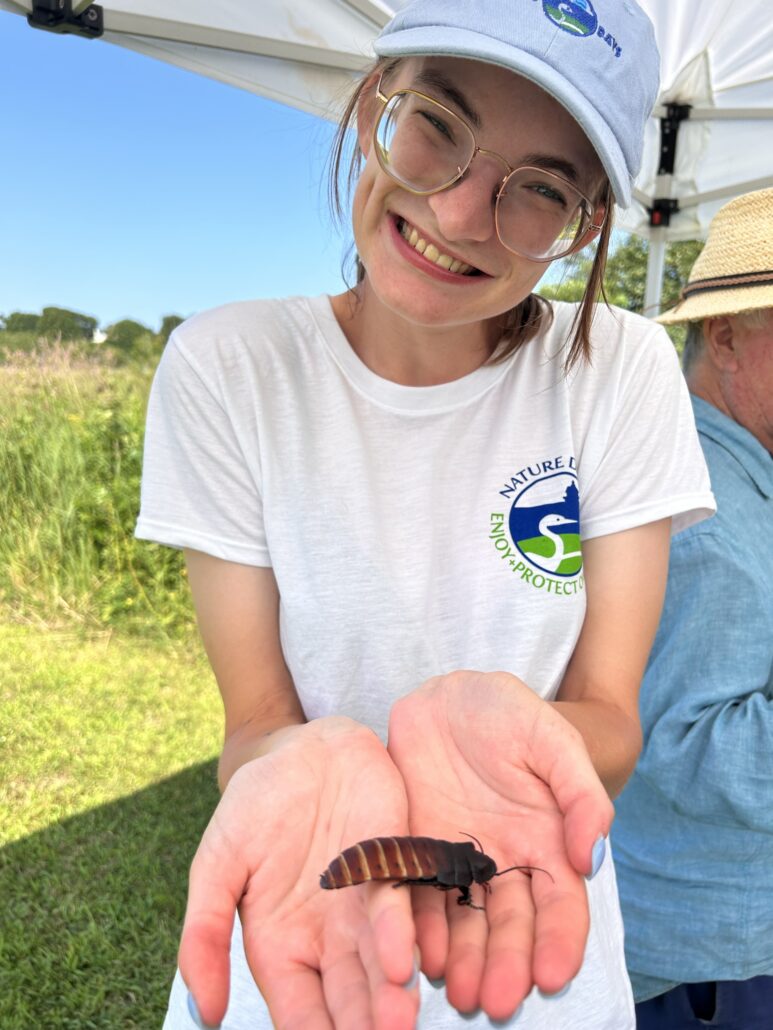
Catalina Berry
A graduate student focused on grassland bird ecology, Catalina previously served as a FIRST team lead and now supports the project from Tarleton. She assisted with data analysis and species distribution modeling.
Jake Davis
Jake, a senior majoring in entomology, focused on invasive species management and digitized insect specimens from past field seasons to strengthen long term biodiversity records.
Carter Perez
Carter is a sophomore in Agricultural Education who previously helped establish baseline data on vegetation, insects, and birds. This year, he supported the team by organizing and analyzing past survey data.
2025 Research Findings
This season, several team members led independent research projects that explored how management decisions influence wildlife and habitat health on Fishers Island.
Tyler McMahon
Plant-Arthropod Interactions in Restored Grasslands
Tyler studied how invasive and native plant communities influence insect populations in restored maritime grasslands on Fishers Island. Because arthropods respond quickly to environmental change and play essential roles in ecosystem function, understanding their relationship with vegetation is key to evaluating restoration success.
During the field season, Tyler sampled vegetation and insect communities across a gradient ranging from native-dominated to nonnative-dominated plant cover. Insects were collected using pitfall traps and identified by taxonomic group and ecological function, such as herbivores and parasitoids. This approach allowed him to examine how both abundance and community structure shift across different vegetation types.
His findings showed that overall insect abundance increased with greater vegetation cover, regardless of whether plants were native or nonnative. However, different functional groups responded in opposite ways, with herbivorous insects increasing in areas dominated by nonnative plants, while parasitoids were more associated with native vegetation . Despite these differences, insect community composition remained relatively similar across the vegetation gradient.
Tyler’s research highlights the complex ways that plant invasion influences insect communities and ecosystem function. His work provides important insight for land management decisions and supports continued monitoring to better understand long-term ecological changes in restored grassland systems.
Naomi Zahn
Arthropod Communities and Knotweed Management
Naomi examined how mowing Japanese knotweed affects arthropod diversity in maritime grasslands. Japanese knotweed is a highly invasive plant that forms dense monocultures along the East Coast, often displacing native vegetation.
During the summer of 2025, Naomi sampled nine 2.5 meter quadrats before mowing and again one month after treatment. Using vacuum sampling and pitfall traps, she collected arthropods and identified specimens to the family level, grouping them by ecological function such as pollinators, predators, and detritivores.
Her findings showed that overall diversity metrics such as species richness and Shannon diversity remained similar between mowed and unmowed plots. However, the composition of arthropod communities shifted. Both treatments were dominated by detritivores, with relatively low numbers of pollinators and predators.
The results suggest that while mowing may reduce knotweed structure, it does not immediately restore functional diversity. Naomi’s work highlights the need for integrated management approaches that consider both vegetation control and wildlife response.
Future work will expand sampling efforts, improve taxonomic resolution, and evaluate additional treatment methods to better inform invasive species management strategies.
Emma Clarke
Symbolic Fencing and Piping Plover Monitoring
Emma focused on monitoring piping plovers, a migratory shorebird listed as endangered in New York State due to habitat loss and disturbance.
Building on the Conservancy’s partnership with the New York State Department of Environmental Conservation, Emma helped survey several state owned beaches during the 2024 and 2025 nesting seasons. In 2025, symbolic fencing and signage were installed at three nesting sites to reduce human disturbance while allowing natural predator interactions.
Emma compared the number of nesting pairs, nests, eggs, and fledglings between 2024 and 2025 to evaluate the effectiveness of symbolic fencing. Preliminary results suggest that symbolic fencing had neutral effects on overall production, while offering a low impact method of reducing human disturbance.
Her work contributes to ongoing evaluation of shorebird protection strategies on Fishers Island. Continued monitoring will help clarify the influence of seasonal variation and other environmental factors on nesting success.
Francisco Salgado
Tree Swallow Nesting in Restored Grasslands
Francisco studied the use of bird boxes by tree swallows in the western restored maritime grasslands. Bird boxes can support grassland bird conservation, but their placement and design influence success.
Over the summer, Francisco surveyed ten bird boxes. Seven were occupied by breeding tree swallows, while three remained unoccupied. Two of the occupied boxes experienced nesting failures.
He also documented differences in box height and design that may have influenced occupancy. One especially low box was not used by birds but instead housed Eastern bumblebees. Francisco also observed other breeding grassland birds nearby, including territorial red winged blackbirds, which may have influenced swallow nesting patterns.
His findings provide valuable insight into how bird box design and placement affect nesting outcomes in isolated grassland systems like Fishers Island. Continued monitoring, earlier season surveys, and more frequent checks will help determine long term nesting success and guide future placement decisions.
Jake Davis
Insect Biodiversity and Reference Network Development
Jake examined insect diversity within restored maritime grasslands on Fishers Island, with a focus on improving how insect communities are documented and understood over time. Insects play a critical role in ecosystem function, but they are often underrepresented in local biodiversity records, making it difficult to track changes or evaluate restoration success.
Using pitfall traps, Jake collected insect specimens from grassland sites and identified them to the family level. Through this process, he documented over 70 different insect families, indicating that restored areas are supporting a wide range of insect life despite past disturbance and invasive species presence.
In addition to documenting diversity, Jake developed a structured, digital reference network using visualization software. This system organizes insect groups into a connected framework, where each taxonomic group is linked with ecological information. The goal of this tool is to make insect data more accessible and useful for long-term monitoring and management.
Jake’s work provides an important baseline for understanding insect communities on Fishers Island. His project helps bridge the gap between field data and usable conservation tools, supporting future research, biodiversity tracking, and more informed restoration strategies.
Walker Barak
Bat Acoustic Monitoring on Fishers Island
Walker studied bat communities on Fishers Island using acoustic monitoring to better understand species presence in restored grassland systems. Bats play an important ecological role, particularly in controlling insect populations, yet many species are in decline and remain understudied in coastal environments.
During the summer field season, Walker deployed acoustic recording devices across seven sites in the western portion of the island. These sites were selected based on features that support bat activity, including canopy cover, access to water, and potential roosting habitat. The monitors recorded ultrasonic echolocation calls overnight, which were later analyzed to identify species.
Through this approach, Walker confirmed that acoustic monitoring is an effective method for detecting bats on Fishers Island, with species such as the big brown bat, eastern red bat, and silver-haired bat identified through their unique call patterns . His work establishes an important baseline for understanding bat diversity on the island, where data has previously been limited.
Walker’s findings highlight the need for expanded monitoring and continued conservation efforts, particularly as land management decisions may impact bat populations and their insect prey. Future work will include increasing survey coverage, incorporating additional environmental data, and partnering with state agencies to further refine species identification and conservation strategies.
Jose Alvarez
Disturbance Impacts on Piping Plover Nesting Habitat
Jose studied the effects of human and environmental disturbance on nesting habitat for the piping plover, a federally threatened shorebird that relies on undisturbed sandy beaches. Because of their sensitivity to changes in their environment, piping plovers serve as an important indicator species for coastal ecosystem health.
During the summer field season, Jose used trail cameras placed along symbolic fencing at a public beach to monitor disturbance near nesting sites. The cameras captured images at short intervals when motion was detected, resulting in over 2,000 recorded disturbance events throughout the study period. These events were categorized by source, including human activity, dogs, boats, gulls, and encampments .
His findings showed that while disturbance was generally infrequent, it could be highly concentrated during short periods, such as holidays, when human presence near nesting areas increased significantly. Notably, disturbance was observed even within protected fencing areas, suggesting that current management strategies may not fully prevent disruptions to nesting birds .
Jose’s research highlights the importance of evaluating how and when disturbances occur in order to improve conservation strategies. His work supports the need for continued monitoring and the development of more effective, less intrusive methods to protect nesting piping plovers on Fishers Island.