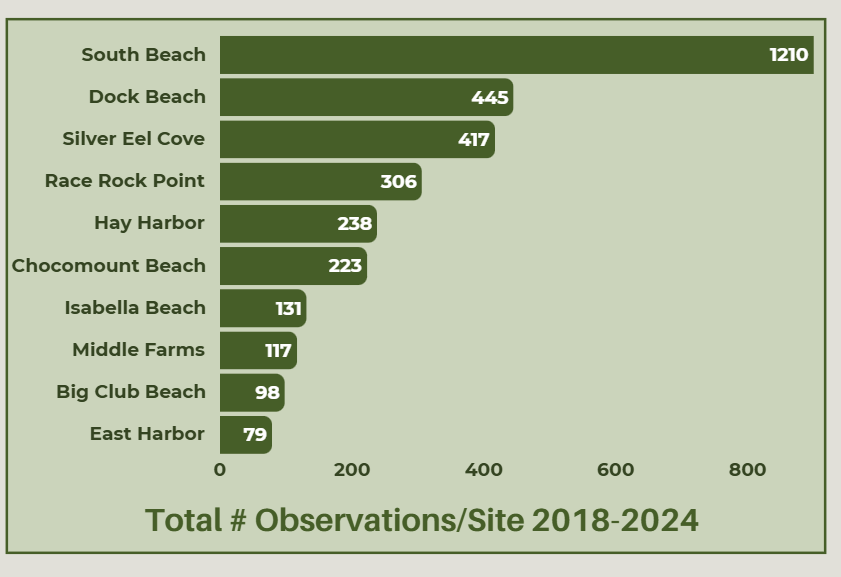
Since 2018, the Island Sentinel program has built a consistent record of observations across ten monitoring sites on Fishers Island. These observations reflect what Sentinels are seeing on the ground and along the shoreline, season after season.
Between 2018 and 2024, Sentinels recorded thousands of individual observations across a wide range of categories. Together, these entries help illustrate how different sites are used, which species are present, and how conditions vary across the island.
Most observations fall into the following categories:
Bird observations, which make up the largest portion of recorded data
Human activity, including recreation and site use
Insects and other wildlife
Boats and vessel activity
Seaweed, natural debris, and marine debris
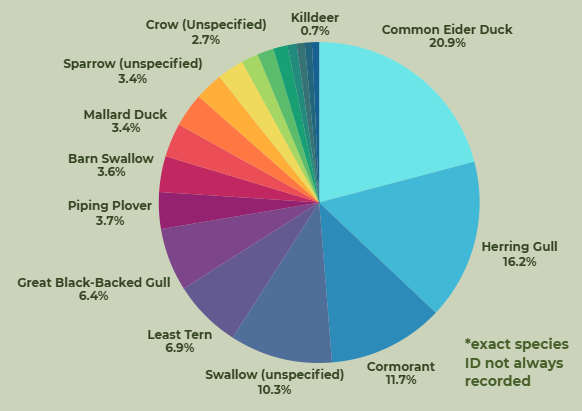
The most commonly observed birds are Eider Ducks, Herring Gulls, and Cormorants. However, NYSDEC endangered species such as Piping Plovers are also observed at many sites.
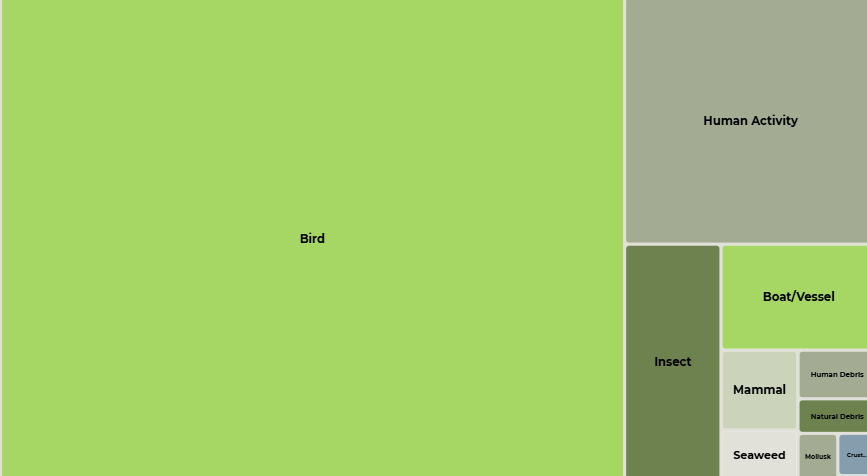
Observations taken by Sentinels are categorized by data type. These include:
Bird – 71.3%
Mammal – 1.5%
Vessel/Boat – 3.9%
Human Activity – 14.7%
Seaweed – 0.9%
Natural Debris – 0.6%
Mollusk – 0.4%
Bivalve – 0%
Crustacean – 0.4%
Human Debris – 0.9%
Insect – 5.4%
Reptile – 0%
It can be seen here that bird observations are by far the most common with 2476 (71.3%) recorded observations over seven years. Human activity is the second most observed with 509 (14.7%). Next are boat/vessel and insect observations 135 (3.9%) & 187 (5.4%), respectively.
Bird observations account for the majority of entries, reflecting both the visibility of birds across the island and the importance of Fishers Island as habitat for coastal and migratory species.
As the program continues, this growing body of observations adds to our understanding of Fishers Island as a living system shaped by both natural processes and human presence. Each season builds on the last, strengthening the record and providing perspective on how conditions shift across the island over time.