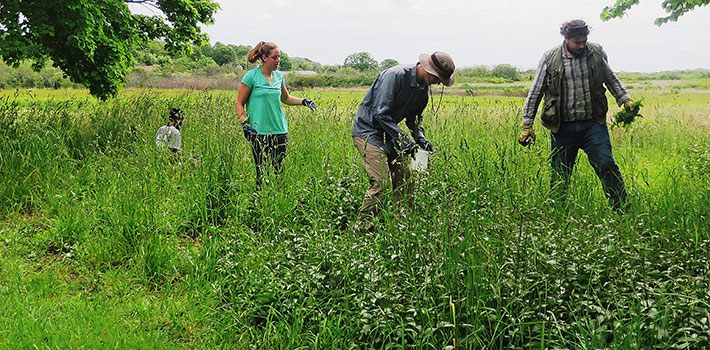
The Weed Team was an early, hands on conservation program created by the Fishers Island Conservancy to address invasive plant species in some of the island’s most sensitive habitats, particularly the Fort Wright Parade Grounds.
Managing invasive plants is not a one time effort. It requires ongoing attention, careful observation, and a deep understanding of how native and non native plants interact. Invasive species can quickly outcompete native vegetation, reducing habitat quality for wildlife and altering entire ecosystems if left unmanaged.
From the beginning, the Conservancy took a targeted, thoughtful approach to invasive plant removal. Rather than broad mowing or mechanical clearing, the Weed Team was trained to identify native, non native, and invasive plants and to remove invasives by hand using species specific methods. Depending on the plant, this included pulling from the root, cutting to the stump, or treating stems and leaves to prevent regrowth.
Invasive plant removal works hand in hand with annual prescribed burns, which are essential for maintaining healthy grassland ecosystems over time.
On June 3rd, 2017, three University of Delaware students arrived on Fishers Island with backpacks, garden shears, and a clear mission. Employed by the Fishers Island Conservancy and trained and supervised by University of Delaware professor Douglas Tallamy, PhD, and his graduate student Adam Mitchell, the Weed Team immediately began work in the Parade G
![]()
rounds.
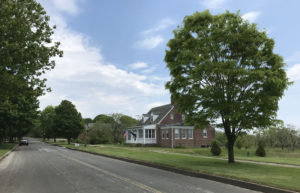
One of the team’s first projects focused on the State Troopers’ Barracks, where a mature autumn olive was removed to prevent further seed spread into the restored grasslands. Although not the only autumn olive in the area, its removal helped reduce seed pressure in the northern portion of the meadow. Native trees were planted in its place, improving both habitat quality and the surrounding landscape.
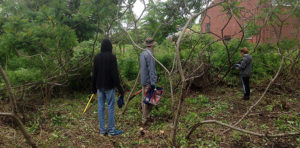
Weed team clears invasives along road east of Movie Theater. Adam Mitchell Photo
Following this initial effort, the Weed Team tackled invasive plants throughout the Demonstration Garden and Parade Grounds, removing truckloads of porcelain berry, oriental bittersweet, bush honeysuckle, and autumn olive. The team also removed and treated a dense patch of black swallow wort across from the entrance to Silver Eel Pond, a species known to threaten monarch butterfly habitat.
The scale and effectiveness of the Weed Team’s work demonstrated what could be accomplished on smaller properties with focused effort and informed management. The Conservancy hoped this work would inspire Island residents to manage invasive plants on their own properties, using the Parade Grounds restoration as a model.
The 2017 Weed Team included undergraduate students Nickia Gibson, Brian Hanlon, and Tessa Hayman. In addition to improving habitat and promoting responsible land management, the students gained valuable real world experience that supported their future careers in wildlife biology and conservation.