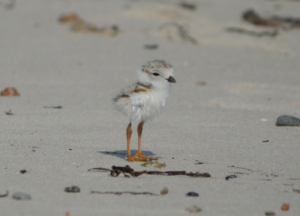
March 31st – 2 adults Piping plovers were spotted foraging
April 9th – symbolic fencing installed with NYSDEC
April 20th – Scraping and courtship display from Piping Plovers
May 4th – Piping plover nest confirmed
May 12th – 1 Piping plover pair foraging observed foraging and nesting
June 2nd – A full clutch (4 eggs) of Piping plover eggs confirmed
June 10th – Observed a third plover on the site further down foraging
June 22nd – 4 Piping plover chicks hatched, brooding observed under adult plover. Chicks are 3 days old.
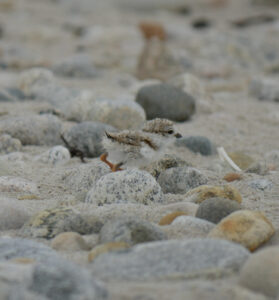
June 24th – 4 Piping plover chicks still on site. Chicks are 5 days old.
June 26th – 4 Piping plover chicks still on site. Chicks are 7 days old. Observed a significant amount of human and wildlife disturbance.
July 1st – 4 Piping plover chicks still on site. Chicks are 12 days old.
July 4th- 4 Piping plover chicks still on site with the 2 active parents. Chicks are 15 days old. Our FIC shorebird monitors were out at this site all day keeping an eye on the family while talking to all of the beach goers about the plovers and handing out educational material.
July 7th- After several days of steady rain, we were only able to locate 3 of the 4 chicks with the adults today. The chicks are 18 days old, mobile but still weeks from fledging, so they can’t fully thermoregulate yet and are vulnerable to prolonged wet, cool conditions. Heavy rain and rough weather can also make it harder for parents to keep the brood together and feeding well, which can lead to chicks getting separated or overwhelmed by exposure. We’ll keep watching closely over the next few days, but a loss like this during a multi-day rain event would be consistent with storm-related mortality at this age.
July 9th- Before our monitors reached the site, we were notified by a shorebird volunteer who was golfing and observed a mink chasing and harassing the plover family, roughly thirty minutes before our team arrived. When we got to the site, only 2 chicks remained with the parents, down from 3. Given the timing, it’s likely predation occurred shortly before our arrival. Minks are opportunistic predators and a known threat to shorebird chicks, especially at this age when chicks are mobile but still small and can’t yet outrun or evade a fast predator. We’ll continue close monitoring of the remaining chicks over the coming days. Chicks are around 20 days old.
July 11th – Our monitor was on site at 1:35 PM but was unable to locate a single plover, chick or adult, despite a thorough check. It was a hot day, so it’s possible the family was tucked away somewhere brooding or seeking shade rather than out in the open. No evidence of feathers or signs of disturbance at the site, though mink tracks were noted, no plover tracks were found alongside them. Prompted a follow up visit the next morning to confirm the family’s status.
July 12th – Following up after not being able to locate the family on site the day before, our monitor got out early this morning to check on them. Beach was busy with a good number of beachgoers out. Relieved to find one adult with one chick, around 25 days old, still somewhat downy but with primary feathers developing, a good sign that this chick could be nearing fledging soon. This is down from the 4 chicks observed on July 4th, so it’s a meaningful drop, but not necessarily a total loss. It’s possible some of the missing chicks have already fledged and are simply ranging further from the nest site with the adults, since chicks at this age become increasingly mobile and independent as they approach flight capability. We’ll continue monitoring closely to see if that’s the case. Also of note, while on site our monitor observed two adult plovers fly in accompanied by two fledged chicks. It’s unclear whether this pair is related to the Eighth Hole family or a separate group passing through, since the resident pair with the one chick became notably territorial toward them, guarding food resources and space. We’ll keep an eye out to see if any connection becomes clearer over the next few visits.
July 14th – Returned to the site today and did not observe any plovers, not even an adult. Of the original 4 chicks, 2 losses have documented likely causes, one to the multi-day rain event on July 7th and one to a mink predation event witnessed by a volunteer on July 9th. A third chick went missing between July 9th and July 12th with no observation during that window, so it remains undetermined. The fourth and final chick, last seen July 12th at 25 days old, healthy and showing developed primaries, is the strongest candidate for a successful fledge, and its disappearance alongside the adult today is consistent with that. We’ll do one more confirmation visit before taking fencing down at this site.Chick that has fledged is 27 days old.
March 29th – First sighting of 2 adult plovers foraging
April 6th – pair observed foraging, off-leash dogs present.
April 20th – a total of 4 plovers observed, 2 pairs. One pair inside fencing
April 23rd – 2 adult plover pairs. Territorial display, pacing, soft calls near fencing.
May 4th – a Piping plover nest confirmed
May 19th – 3 plover pairs observed! 1 pair nesting in the fencing. 1 Least tern pair spotted.
June 1st – Only 1 plover pair was seen and this pair hatched 3 chicks. Chicks are around 4 days old. Least tern pair nesting.
June 2nd – No plover chicks observed with adult pair. Chicks are gone. Possible human or wildlife disturbance. Pair will be restarting on 2nd nesting attempt soon. Least tern pair still has its nest with 2 eggs
June 10th – Pair of plovers starting to work on the 2nd nesting attempt. Hoping to see eggs soon. Least tern nest still active with 2 eggs. Another pair of terns showed up and displaying courtship behavior.
June 17th – the plover pair has a full clutch (4 eggs). Least terns still active and vocal with one of the two pairs that has 2 eggs.
June 22nd – Plover pair with full clutch still. Least tern pair hatched 2 chicks. Least tern chicks around 5 days old. The other tern pair still has no nest.
June 26th – Plover pair with full clutch still. Least tern pair still has 2 chick. Chicks are 9 days old.
July 1st – Plover pair with full clutch still active nesting. Least tern pair still has 2 chick. Chicks are 14 days old. The second Least tern pair is starting to nest!
July 4th- Went into the long weekend a bit concerned about human activity at this site, but the tern pairs turned out to be more than capable of handling it themselves. They were notably territorial and aggressive today, dive-bombing and vocalizing at anyone who got close, myself included. Their aggression is doing exactly what it needs to, keeping people at a distance. 1 tern pair still guarding 1 chick. Originally had 2 chicks, the second wasn’t visible today, possible it was just well hidden. Least tern chicks are 17 days old today. 1 plover pair still going strong with the full clutch of 4 eggs. A second tern pair is showing confused, pre-nesting behavior, close enough to the other plover pair on site that it’s worth keeping an eye on. The second plover pair, nesting directly on the rocks, is doing well. Had a safe opportunity to approach and confirmed 3 eggs in the nest. Least tern chicks are 17 days old today
July 7th- 4 Piping Plovers spotted total, both pairs still active on site. Least Tern pair now has 2 chicks. Tern chicks are 20 days old. Tern activity remains high, lots of dive-bombing and vocal defense again today.
July 13th – Returned to the site today after giving the family space since our last visit on July 7th, wanting to minimize disturbance during this critical hatching window. Glad we did, as we’re now seeing 2 freshly hatched plover chicks with the pair, likely only 1 to 3 days old based on their appearance, still fully covered in soft down with no visible primary feather development along the wings yet. They stayed close to the adults and showed typical newly hatched behavior. There are still 2 eggs remaining in the nest that have not yet hatched. It’s common for eggs within the same clutch to hatch a day or two apart, so there’s a good chance those could still hatch soon if given a bit more time. We’ll continue to keep our distance and limit site visits where possible to avoid adding stress during this sensitive period.
July 14th – Site visit conducted this morning during low tide. Observed 7 Least Terns (LETE), 3 Piping Plover (PIPL) adults, and 2 Piping Plover chicks. A brief scuffle occurred between a Least Tern and a Piping Plover, consistent with the high territorial activity we’ve seen from the terns at this site all season. No update yet on the 2 remaining unhatched eggs.