Horseshoe crab spawning study
The NYSDEC / Cornell Cooperative Extension Horseshoe Crab Spawning Study is a collaborative conservation and research effort that was initiated in 2004. Cornell Cooperative Extension’s Marine Program and Stony Brook University work with the New York State Department of Environmental Conservation to coordinate and implement this project. The study monitors spawning horseshoe crabs at sites throughout Long Island and across New York’s Marine District to gain a better understanding of their abundance and distribution in New York State.
The intent of this statewide network is to encourage community participation in annual horseshoe crab monitoring efforts. Participants assist with the collection of scientific data that is used to assess the status of horseshoe crabs in New York State and to inform the management and conservation of this important species throughout the region.
There are currently 28 reference beaches participating in the study, and the Fishers Island site has been monitored since 2014 by the Fishers Island School. The data collected at these sites is used to assess the status of horseshoe crabs in New York State and to help inform management and conservation decisions for this important species.
The Fishers Island Monitoring Site
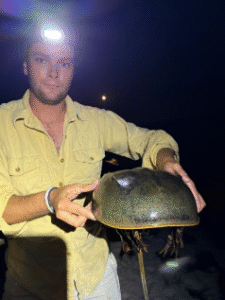
Beginning of 2024, FIC Sentinels were asked to help support the collection of data for the NYSDEC Horseshoe Crab Spawning Study by assisting with surveys alongside the Fishers Island School. The Fishers Island monitoring site is located at Dock Beach and is officially adopted and coordinated by the Fishers Island School as part of the statewide horseshoe crab spawning study.
What Monitoring looks like
During late spring and early summer, adult horseshoe crabs travel from deeper ocean waters to beaches where they spawned to breed. Horseshoe crabs breed at night during high tides associated with new and full moon phases.
The NYSDEC prepares a monitoring schedule based on local tide and moon phase conditions from mid May through mid July. Study participants typically conduct surveys at night and are asked to bring a headlamp and wear water shoes.
Once at the site, environmental conditions including air and water temperature, tide, water clarity, and weather are recorded. The designated transect is walked from beginning to end and the number of horseshoe crabs and their activity is documented. Data collected includes spawning abundance, size, sex, and tag returns at the site.
If untagged horseshoe crabs are observed, they are tagged with a unique identifier according to established NYSDEC protocol. All data collected during surveys is submitted to NYSDEC for inclusion in the annual Horseshoe Crab Spawning Activity Survey.


Sentinel participants
2024 Sentinel Participants
Nicolas Hall
Anna White
Jessica NeJame
Elsie Harrington
Teddy Schaffer
Riley Tracy
George Hanes
2025 Sentinel Participants
Nicolas Hall
Riley Tracy