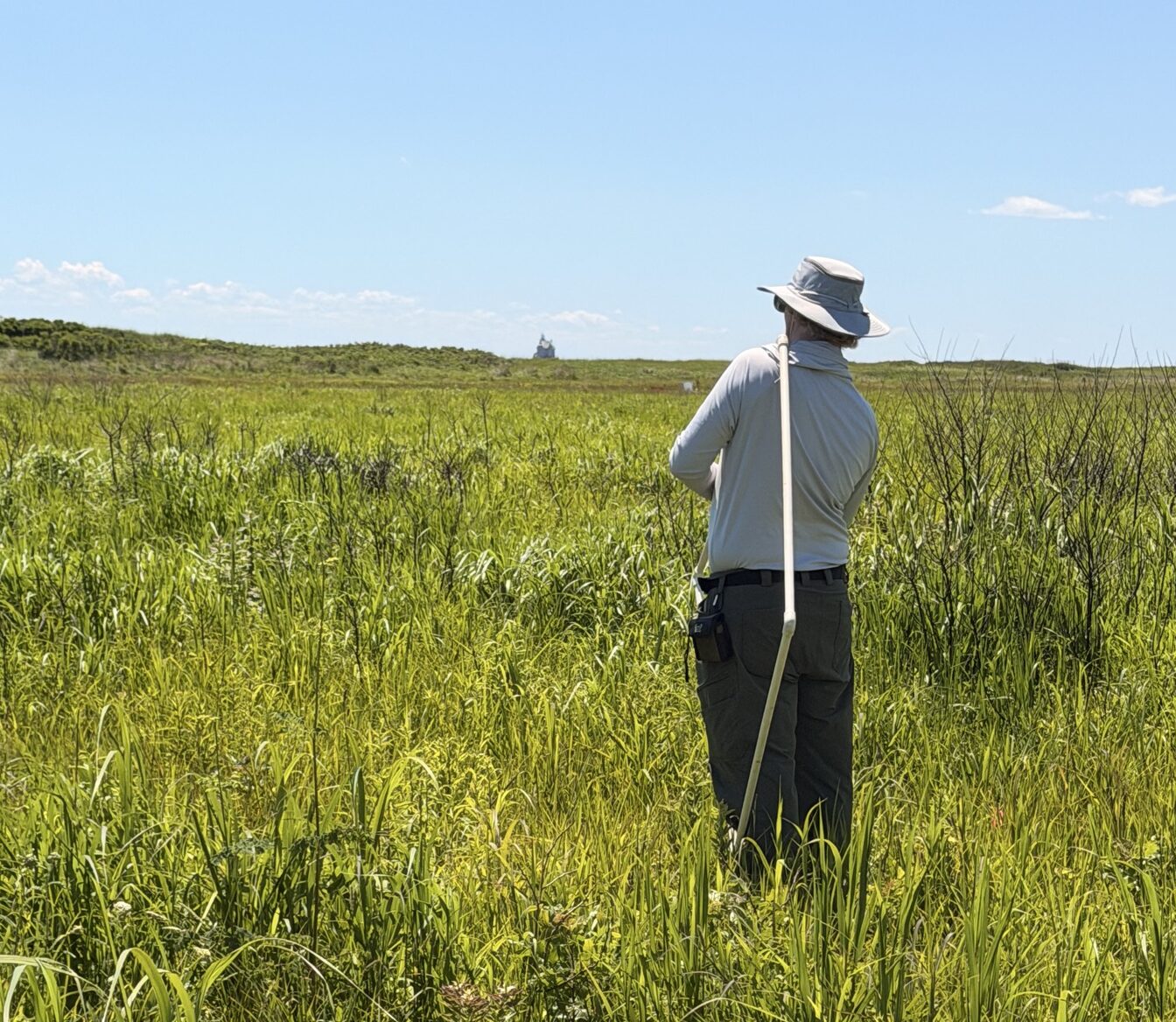
Summer is in full swing on island, and the FI Research and Survey Team is deep into the field! Alongside their work with the Conservancy, each student gets to pursue their own independent research project tied to their college coursework, and this season they have brought some really exciting science to Fishers Island. Here is a look at what Naomi and Natalie have been working on this June and July!
Natalie Sato – What Invasive Plants Leave Behind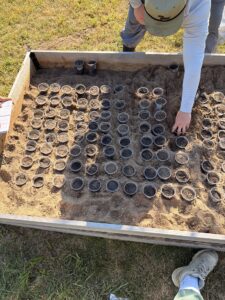
Even after an invasive plant is removed, its effects on the soil may linger long after it is gone. Natalie is investigating this idea through the lens of allelopathy, a process by which invasive plants release chemical compounds into the soil that can suppress the growth of native plants nearby. Her focus is Japanese knotweed, one of Fishers Island’s more stubborn invaders, and whether the soil it leaves behind continues to inhibit native plant growth even after the knotweed itself has been removed or managed.
To test this, Natalie collected soils from four different site types around the Parade Grounds, areas actively dominated by knotweed, sites that have been mowed, sites that have been chemically treated, and native reference grasslands with little to no invasive presence. She is growing two native plant species, black-eyed Susan and Virginia wild rye, in cups packed with each soil type to measure germination success and plant growth over six weeks.
The experiment is housed in a raised bed near the native garden, which the team fully prepped for the project by pulling mugwort, transplanting remaining native vegetation, and replacing the soil with heat-treated topsoil. If Natalie’s hypothesis holds, plants grown in knotweed-invaded soils will germinate and grow more poorly than those in native soils, and the addition of activated carbon to the soil will help confirm whether those chemical compounds are the culprit. Her results could have real implications for how restoration efforts on the island approach reseeding and soil management after invasive removal.
Naomi Zahn – What Happens to the Bugs When the Knotweed Is Removed?
Now in her third year with FIRST, Naomi is continuing her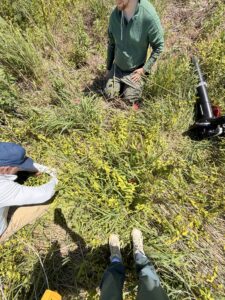 investigation into Japanese knotweed’s impact on arthropod communities in the Parade Grounds. While a lot of invasive species management focuses on the plants themselves, Naomi’s work asks a different question: what happens to the insects, beetles, spiders, and other ground-dwelling creatures when knotweed is removed or disturbed?
This season, Naomi established ten sampling sites within areas of 100% knotweed cover, collecting arthropods from the foliage using vacuum sampling and deploying pitfall traps in the ground at each site. After getting her pre-mow samples in place, a small logistical hurdle came up when the mower typically used for the Parade Grounds went out of service. The team coordinated quickly with the Conservancy and Race Rock Garden Company to get it sorted out, and mowing ended up happening ahead of schedule, wrapping up over the weekend.
With the treatment now in place, Naomi has entered a one-month waiting period, giving the knotweed time to begin regrowing and the arthropod communities time to respond before she goes back in for a second round of sampling. The comparison between pre- and post-mow communities will help shed light on how management practices ripple through the food web in ways that are easy to overlook.